
I’ve never been one to wake to the violent demands of an alarm clock. Perhaps that is why I found myself moving to Guatemala in 1987.
Around 3am the crow of a rooster lightly registers in my brain. At 530a a penumbra begins to brighten the sky just as the tuctuquero’s two-stroke engine breaks the morning silence. I am awake. It suits me, living in the Central American belly of our blue marble with daylight never dipping below 12 hours nor exceeding 13.
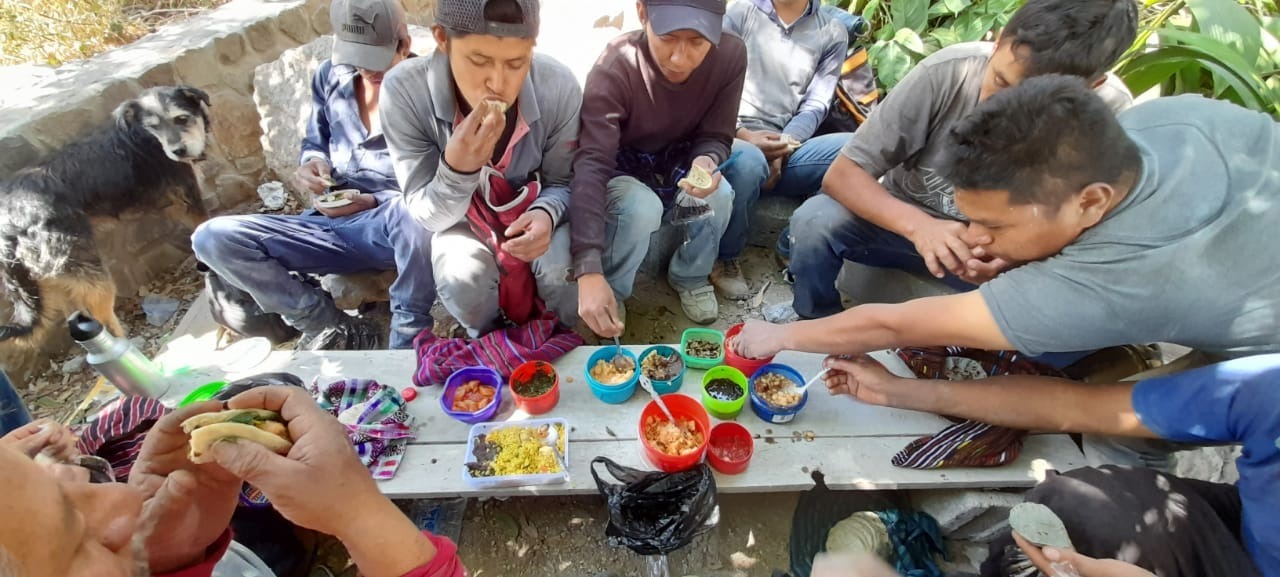
Managing construction projects in a culture that perceives time with less urgency than my birth culture can be a challenge especially for my clients that are new to Guatemala. In my architecture office we use a variety of tools to keep projects on budget and on time. We develop detailed Gant Charts so long-lead items are ordered in advance and critical path items are executed in a timely manner. With very good reason the masons orchestrate the teams. Unlike carpenters, who lovingly belabor their work with little regard to the clock, albañiles are notoriously punctual. Work begins at 7am. Morning snack 10a-10:15a. A sort of potluck lunch begins at 1p. Sometimes their wives show up with warm food and the team sits in a circle sharing out of each other’s containers, tortillas as their utensils. And at 4p, a rapid fire ricochet of voices proclaim, “Ho muchá!,” the Cakchiquel equivalent of “Quittin’ time!”
But punctual masons and Gant charts can’t stem the tide of unexpected delays usually wrapped in corruption. Product shortages, Customs snafus, moving-target paperwork by regulatory agencies, frequent road blocks and protests (sometimes against corruption!), fuel shortages, elimination of the postal service, and even a shortage of cash in the banks, all have contributed to delays that leads one to shrug their shoulders in resignation and exclaim, “Fijase!”, a catch all phrase that could be interpreted as, “Let me tell you how my problem has become your problem”.
Guatemalans have an unhurried awareness of time quite in contrast to the accelerated, “in a New York minute” English, German and US awareness. Over the years, this has lead to some creative solutions to assure that an international crowd show up at the same time. One year, we hosted a fundraising event for my son’s grade school. Germans and Americans were given an invitation for half an hour later than the starting time and the locals were told it was starting an hour prior. In Guatemala it is considered impolite to show up early or even punctually, perhaps indicating too much hunger or ambition.
Time is not money in Guatemala. In fact, offering double pay for overtime rarely results in longer work hours or a more productive team. My perception is that time is measured by church bells, bus horns, local food markets, and the movement of the stars. Time is consumed doing an honest days work and then being with family and friends. The being is equally if not more important than the doing. There is a certain Allowing in the equation. Allowing for common humanity, imperfection, the unexpected and accepting that some things, like death and hurricanes can’t wait. On those occasions, the doing stops and the support and being in community takes priority. Like the moment before a car crash, time slows and takes on more clarity. But, this slowing is acknowledged and embraced with a simple tender resignation.
In April of 2006, the Guatemalan government preposterously announced a new Daylight Savings Time policy. But, in the agricultural highlands, children continued to show up for school after their breakfast. Some asked for clarity, “ Is that 8am God’s time or government time?” The experiment was truncated before the 6 months were up. Roosters, stars, the crops and the Maya had no need for government machinations.

Leave a Reply